
Home › Forums › Horse Racing › @Nathan Hughes – 19th Century Horse Racing Art
- This topic has 4 replies, 4 voices, and was last updated 10 years, 4 months ago by
 Seasider.

- AuthorPosts
- January 11, 2016 at 23:17 #1229310
Nathan:
As promised in the quiz thread, here are more paintings featuring flying horses. They are included because I like them rather than for any particular artistic merit.
Above is a painting by Alfred Wheeler showing the closing stages of the 1892 Eclipse. The jockey on Orme (yellow colours of the 1st Duke of Westminster) looks more than a little concerned as Orvieto threatens to come upsides, but the pair rallied to win by a neck. As in other examples of horse racing art, this painting may not represent how the race was actually run.
http://art-now-and-then.blogspot.co.uk/2013/01/sports-painting.html
The 4th image down is a painting of the finish of the 1831 St Leger won by Chorister from The Saddler. There’s a lot to take in here, which is why many people don’t like it. Personally I like it for that very reason. The Doncaster stands and the crowd give it much appeal. As side note, I’m worried that the man standing on the course at the left of the painting is going to get totalled by the horse running up the stand rail. Let’s hope he survived.
http://myinwood.net/wp-content/uploads/2009/02/horse-race-19th-century.jpg
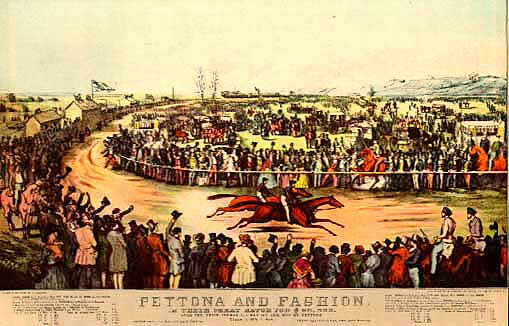
Here is a painting of a race that took place on Long Island in 1836. Again, it’s the crowd that bring this to life for me, together with my impression that the track design was based on Chester, only much smaller.
Plenty of other images are available but it’s a matter of personal choice as to whether you like them or not.
January 12, 2016 at 10:16 #1229331Thank You, Seasider for posting this up.
I’ll keep my eye out for these when scrawling the antique Aquariums with deaf Jon.
I do like that bottom one and like you say the crowd brings it to life.
I was in a charity shop yesterday and was talking to the owner who said she has a 1000 piece jigsaw puzzle of Epsom which is years old and will bring it in for me the next time I’m in Exeter which will be about 3 months time for my hospital check up, so I’m quite looking forward to seeing that, she said the crowd around it is very good and you can almost smell the atmosphere.Gaelic Warrior Gold Cup Winner 2026
January 12, 2016 at 10:49 #1229336I have a print of a very similar St Leger picture by the same artist, this one showing the finish of the 1836 race. The picture is drawn from the opposite side of the course, but with the same stands on the left side, and it also features a number of identically dressed men standing on the course at regualr intervals along the rails. I suspect they may be the early 19th century version of the stewards, watching out for foul riding.
Here’s the best version of it I can find online:
January 12, 2016 at 10:57 #1229338There are some people in that St Leger painting that are still at the bar…
January 12, 2016 at 23:06 #1229408I have a print of a very similar St Leger picture by the same artist, this one showing the finish of the 1836 race. The picture is drawn from the opposite side of the course, but with the same stands on the left side, and it also features a number of identically dressed men standing on the course at regualr intervals along the rails. I suspect they may be the early 19th century version of the stewards, watching out for foul riding.
Here’s the best version of it I can find online:
You probably know this already.
The 1836 renewal was notable for a considerable gamble on the winner, Elis. In a time when horses had to be walked to the racecourse, the horse was a 100/8 chance several days before the race because he was still in his stable at Goodwood, and the bookmakers didn’t think he could reach Doncaster in time for the start. However Lord George Bentinck (the owner) had a special carriage built to get him there, the conveyance being pulled by six horses capable of travelling 80 miles per day. Having availed himself of all prices from 100/8 downwards, Bentinck (and Elis) arrived at the racecourse well before the race and the fresh and rested horse sluiced in at 7/2. This was the first time ever a horse arrived at a racecourse without having to walk there.
It is unclear how much Bentinck made on the race. One source states he cleared £24,000, while another reports a single bet of £61,000 to £12,000 (amongst other wagers). We just don’t know, but if the single bet alone is true then Bentinck was about £5m better off (in today’s money) after the race. If he only won £24,000 that sum should be reduced to a mere £2m (in today’s money).
- AuthorPosts


- You must be logged in to reply to this topic.