
- This topic has 10 replies, 8 voices, and was last updated 13 years, 1 month ago by
 Professortrubshawe.

- AuthorPosts
- April 16, 2013 at 18:37 #23880
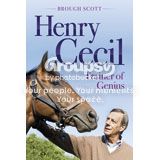
<i>I thought I’d pass on my thoughts on Brough Scott’s new book on Sir Henry Cecil.</i>
In some ways writing a book about the life of Sir Henry Cecil should be the easiest thing in the world. A story with more drama and plot twists than the most gripping of novels and a ready-made hero already beloved by all and sundry. All the ingredients of any epic tale are present. How could you fail?
It’s not that simple though. The problem faced by Brough Scott, writer of the newly-published Cecil biography “Henry Cecil: Trainer Of Genius”, is that Cecil’s professional profile has always been such that his life has always played out in the full glare of the public spotlight. In essence, we all already know the Cecil story. The aristocratic background, the marriage into racing royalty, the meteoric rise, his establishment as one of the great classic trainers of all time and the personal problems which precipitated an unravelling of much that he had built in life. All followed by a glorious resurrection which was, somewhat incredibly but equally fittingly, capped by his finding himself training the greatest thoroughbred racehorse the sport had ever seen.
The only avenue open to Scott, other than a simple re-telling with a new spin, was to delve into the detail and assemble some of the pieces of the picture of Cecil that exist both beyond the public gaze and apart from the feats that led to his position as the pre-eminent racehorse trainer of his generation.
As a seasoned Cecil fan, like almost all of us who have racing as an interest, I am familiar with the story and one of the things I wanted from this book was new detail, the stuff I never knew already. And to Scott’s credit, the book contains enough of that to satisfy.
The biography begins, as you would expect, with a detailed description of Cecil’s background and upbringing. Conventional or ordinary it was not and how much of it shaped the complicated man Cecil became in adulthood can never be clearly understood.
However, you cannot help but think that the psychological ravages of those early years at prep school (the sculptor of human frailties in later life for countless individuals) and unusual domestic arrangements may well have informed his propensity to uncertainty in his personal life but, just as surely, may have also instilled the need for an all-consuming diversion from the pain of daily life. He didn’t have to look far from his front door for that diversion.
Scott recounts those early years and the subsequent embryonic growth of an interest in racing, as it developed within the foppish, party-loving Cecil, with the skill and craft you’d expect from one of the premier racing journalists of the last 50 years. The research is diligent and the style highly readable.
His picture of the hapless and, according to the general view held at that time of both Henry and his twin David, hopeless figure that emerged from a singularly unpromising scholastic career, is painted endearingly but without over-sentimentality. And how different our racing world may have been had twin David, who was first offered the assistant’s job with step-father Sir Cecil Boyd-Rochfort, not wished to escape from beneath the all-seeing gaze of the formidable master of Freemason Lodge leaving the path clear for his brother Henry to take his place.
The remainder of the first half of the book details Cecil’s time as assistant to his step-father, his fledgling training career, the rapid rise through the ranks through to the time by which, at the end of the 1970’s, he had become the most glittering of stars among the Newmarket training ranks. His achievement in 1979 in notching up a winners/runners strike rate of 45% was not only remarkable in its own right but also sealed his place as a trainer in whom the public felt they could place faith and marked the beginning of the unique and mutually respectful relationship between trainer and public, a respect which has endured to this day.
Although most of us will be familiar with much of this part of the Cecil tale, Scott’s telling of the story of how, by the mid-80s, Cecil had conquered the racing world and had, even at that relatively young age in racehorse-trainer terms, cemented legendary status is, again, highly readable and absorbing. Those of us old enough to remember them will find the heady days of the 70s and 80s brought back to life, not as dusty relics but brought to the page by Scott in such a way that the story retains a freshness and vitality.
And then, as the end of the 1980s approached and with the racing world at his feet, as we all know, the wheels of the Cecil juggernaut started to wobble loose.
Since publication of the biography, Cecil has taken his unease at Scott’s inclusion of intimate details relating to some of his personal challenges into the public domain via some fairly strongly worded statements. It’s clear that he wouldn’t have taken that step without there being considerable discomfort on his part at the inclusion of what he no doubt regards as private matters. But it is equally clear that without the inclusion of this side of the Cecil story Scott’s biography would be a limp affair, a mere recounting of racing results without that very necessary biographical factor, an insight into the subject and what made and makes him the man he is.
Scott will, no doubt, be ‘mortified’, as one journalist put it, by Cecil’s highly public statements on the biography, but I found his recounting of the facts surrounding some of Cecil’s most controversial moments sympathetic, without being unnecessarily so. It’s difficult, for example, to find much sympathy for Cecil over the drink driving incident which led to the injury of an eldery person and which could have resulted in much worse.
The events precipitating the unravelling of the Cecil empire in the late 1990s and during the first few years of this century are looked at in some depth and it is clear that Cecil’s own human frailties played a major part in that spectacular decline. It reads, at times, like a Greek tragedy. But, I’m afraid, whether he, or we, like it or not those dark days, and at their worst they were very dark indeed, are part of the Sir Henry Cecil story. An integral part and, notwithstanding the rights and wrongs of any formal or informal agreement between author and subject regarding content, a part without which the biography would have only been half the story. It is impossible to separate the racing story from the more painful personal journey that Cecil has travelled. And it is to Scott’s credit, as a biographer, that he doesn’t attempt to do that.
The final quarter of the book concerns itself with the climb back from what the book describes in a chapter title as ‘the depths’ to the miraculous resurgence which saw Cecil recover from a position where he trained only twelve winners in an entire year and was renting out parts of the famous Warren Place yard to make ends meet to having in his care a horse who was not only a classic winner but became widely recognised as the finest thoroughbred ever to have raced.
The book is a holistic account of the remarkable story of a charismatic, brilliant but, ultimately, fallible individual. Written well, by someone who has observed Cecil’s career from close quarters since its very beginnings, it is a comprehensive work whose goal is to provide an authoritative, lasting account of the trainer’s life and career. And, by and large, it succeeds in meeting that objective.
There are some caveats however. Scott is prone, on occasions, to minor bouts of self-indulgence. This isn’t pronounced enough to spoil the book but it can be an irritation. He is also sometimes hesitant or guarded in his criticism, when criticism is called for, of Cecil and other racing figures, mindful perhaps of the sensitivities that exist in the narrow and incestuous confines of the racing world. Perhaps rightly so in light of subsequent events!
The other factor that spoils the book is that the paper quality is such that the black and white photos which accompany the text are poorly reproduced. There are three short sections of photos which are adequately printed but the photographs which are placed outside these, within the general text itself, would have been better left out or the paper quality improved. For a book that has been eagerly awaited and is clearly hoped by the publishers to be seen as important, this is disappointing.
However, those criticisms aside, Brough Scott’s book is an indispensable addition to the library or coffee table of anyone interested in Sir Henry Cecil and his story, or indeed flat racing generally over the last fifty years. Whether it will become the definitive account of the legendary trainer’s life remains to be seen but it is certainly the most authoritative and complete to date. I found it absorbing and also felt that it struck the right balance between the portrayal of the genius racehorse trainer and of the more uncertain human being we know him to be.
Cecil’s appeal is almost universal. In part that appeal is generated by those qualities that have seen him establish a reputation as one of the all-time great racehorse trainers. But, just as he can intuitively understand a racehorse, so we can intuitively understand him and recognise that, for all his undoubted gifts in his chosen profession, outside that realm there exists within him the same frailties that possess us all in similar and differing ways. And that fragility of character, often laid bare during his life, draws people to Cecil just as surely as the great racing triumphs.
Brough Scott has captured and articulated these twin threads of Cecil’s appeal pretty well, making this a book any racing fan should not miss.
April 16, 2013 at 18:54 #436450Fantastic post Corm. Can’t wait to get my copy! Hope it’s as good as that review!
"this perfect mix of poetry and destruction, this glory of rhythm, power and majesty: the undisputed champion of the world!!!"
April 16, 2013 at 20:27 #436463Hmm… might have to rethink it then Cormack. That’s a seriously positive revue. Thanks.
 April 16, 2013 at 20:52 #436466
Fantastic revue Cormack, I think you should have approached Sir Henry to write his story.

Still worries me why Sir Henry felt betrayed by Brough Scott and will not endorse any of the books with his signature.
Having read the book did you feel it was a true portrayal of Sir Henry’s life or did you feel there were aspects that betrayed a trust between subject and author?
Sir Henry himself said that there wasn’t enough humour in the book. Did the fact that there are no actual interviews with Sir Henry make the book more of a factual biography rather than a heartwarming insight into the life of the most charismatic and brave man in Horseracing?
JacThings turn out best for those who make the best of how things turn out...April 16, 2013 at 20:55 #436467No point in buying the bloody Book now!!
April 16, 2013 at 21:06 #436468An interesting review, but I disagree with the central thrust of your opinion.
So, the most informative, interesting and essential part of the book is about a man’s two marriages falling apart and his brother dying, with at least one of the marriages associated with marital infidelity. Since 42% of marriages in the UK now end in divorce, I hardly think that it is the life-shaper and career-shaper that might be implied here.
“But it is equally clear that without the inclusion of this side of the Cecil story Scott’s biography would be a limp affair.”
Are you implying that we would never have understood Sir Henry’s “genius as a trainer” if he had stayed married to his first wife, and his twin brother had not died? Is it therefore worth the purchase price? If yes, then I assume that you conclude that the downward trend of Sir Henry’s career was due to the problems of his second marriage. I admit it does make a more modern, “reality TV” take on the situation than the alternative, which I assume you dismiss as something of little credibility – the aspergillus fungus.
Calling in the experts from the Irish Equine Centre’s microbiology department, to identify and then institute procedures to eradicate the fungus just in time for Sir Henry to come to his senses and start training winners again was not a significant fact, I guess. It’s a good thing that Dessie Hughes did not have to suffer the same issues when he had a slump caused by the same fungus in his yard. After spending all that expertise and effort, Professor Tom Buckley with Alan Creighton and his team travelling the world sorting these problems out, and receiving no plaudits from their most high profile case. Pehaps that part did not happen at all, maybe it was just a ruse to blind us to the obvious.
A broken second marriage, aspergillus infestation leading to aspergillosis in the horses, and a slump in form lasting several years. How should cause and effect be apportioned? I suppose it is a matter of opinion.
We did hear a lot about Sir Henry Cecil the man, but Brough Scott’s inability to establish a relationship with him, meant we received none of Sir Henry’s thoughts at all about what makes him a Trainer of Genius. I was really hoping for a lot of input to this book from Sir Henry. Scott sacrificed the book I wanted to read because he thinks that the modern audience wanted a whole chapter that was a bit more emotional and heart-rending. The Mills and Boon of racing biographies.
April 16, 2013 at 21:33 #436471Jac –
I’ve no idea if there was a breach of trust as I’ve no idea what the basis of any agreement between Sir Henry and Brough Scott (if any existed) was.
I would say that I felt the book was a very fair, honest and true portrayal (in as much as I understand the truth of Cecil’s life to be). I am sure there may be people close to Cecil, including the great man himself, who may feel the portrayal is perhaps unbalanced and that certain aspects have been overplayed but I would disagree (I explain why in the review).
It’s not a particularly heart-warming biography, in the sentimental sense at any rate, Jac but I think Scott does convey a sense of what Cecil has been through and how bravery has played a leading role in how he has faced those challenges. I was a little glad it wasn’t overly sentimental and gushing to be honest.
It does seem a little odd that Scott seemingly spent so much time at Warren Place yet has so little first hand account from Sir Henry Cecil. Again, I’ve no idea what the situation was so wouldn’t be able to comment. I think the inclusion of more of Cecil’s commentary on the key events would clearly have enhanced the book but I still think it’s a reasonably complete (and enjoyable) account.April 16, 2013 at 21:47 #436475MV – I never said this…
the most informative, interesting and essential part of the book is about a man’s two marriages falling apart and his brother dying, with at least one of the marriages associated with marital infidelity.
But what I would argue is that those events were highly significant and are essential elements, along with all the other key events (including the fungus eradication), in any account of Sir Henry Cecil’s life.
April 16, 2013 at 23:51 #436485A lot of work in that fine review, Cormack – thanks.
I believe it should not be forgotten that Brough Scott, on top of whatever other talents he might have, is a journalist. It would have been a notable dereliction of journalistic duty to leave out the troubled periods in the life of his subject, whether it was Henry Cecil or anyone else.
I do not know Mr Scott and can only offer an opinion on what I’ve read about him and by him: he seems to me to be an honourable man. His writing style sometimes grates, but at other times he nails it – a bit like many of us in our jobs/lives I suppose.
As to the production quality of the book, a number of Amazon reviewers share Cormack’s dismay. Why the Racing Post would risk damaging its brand for a saving of about 50p a copy (an educated guess), heaven knows.
Getting anything published in print these days is a challenge for most authors, and I’d have thought there’s a nice niche there for Betfair/Timeform given the Halifax company’s 65 years’ experience in publishing quality products.
April 17, 2013 at 18:54 #436552RP have been in touch to say that the first print run has now sold out and that they are doing work on the b/w photos to improve for next print run.
April 20, 2013 at 16:12 #436868http://i840.photobucket.com/albums/zz321/cormack15a/henrycecil2_160_zpsa4f429eb.jpg
I thought I’d pass on my thoughts on Brough Scott’s new book on Sir Henry Cecil.
In some ways writing a book about the life of Sir Henry Cecil should be the easiest thing in the world. A story with more drama and plot twists than the most gripping of novels and a ready-made hero already beloved by all and sundry. All the ingredients of any epic tale are present. How could you fail?
It’s not that simple though. The problem faced by Brough Scott, writer of the newly-published Cecil biography “Henry Cecil: Trainer Of Genius”, is that Cecil’s professional profile has always been such that his life has always played out in the full glare of the public spotlight. In essence, we all already know the Cecil story. The aristocratic background, the marriage into racing royalty, the meteoric rise, his establishment as one of the great classic trainers of all time and the personal problems which precipitated an unravelling of much that he had built in life. All followed by a glorious resurrection which was, somewhat incredibly but equally fittingly, capped by his finding himself training the greatest thoroughbred racehorse the sport had ever seen.
The only avenue open to Scott, other than a simple re-telling with a new spin, was to delve into the detail and assemble some of the pieces of the picture of Cecil that exist both beyond the public gaze and apart from the feats that led to his position as the pre-eminent racehorse trainer of his generation.
As a seasoned Cecil fan, like almost all of us who have racing as an interest, I am familiar with the story and one of the things I wanted from this book was new detail, the stuff I never knew already. And to Scott’s credit, the book contains enough of that to satisfy.
The biography begins, as you would expect, with a detailed description of Cecil’s background and upbringing. Conventional or ordinary it was not and how much of it shaped the complicated man Cecil became in adulthood can never be clearly understood.
However, you cannot help but think that the psychological ravages of those early years at prep school (the sculptor of human frailties in later life for countless individuals) and unusual domestic arrangements may well have informed his propensity to uncertainty in his personal life but, just as surely, may have also instilled the need for an all-consuming diversion from the pain of daily life. He didn’t have to look far from his front door for that diversion.
Scott recounts those early years and the subsequent embryonic growth of an interest in racing, as it developed within the foppish, party-loving Cecil, with the skill and craft you’d expect from one of the premier racing journalists of the last 50 years. The research is diligent and the style highly readable.
His picture of the hapless and, according to the general view held at that time of both Henry and his twin David, hopeless figure that emerged from a singularly unpromising scholastic career, is painted endearingly but without over-sentimentality. And how different our racing world may have been had twin David, who was first offered the assistant’s job with step-father Sir Cecil Boyd-Rochfort, not wished to escape from beneath the all-seeing gaze of the formidable master of Freemason Lodge leaving the path clear for his brother Henry to take his place.
The remainder of the first half of the book details Cecil’s time as assistant to his step-father, his fledgling training career, the rapid rise through the ranks through to the time by which, at the end of the 1970’s, he had become the most glittering of stars among the Newmarket training ranks. His achievement in 1979 in notching up a winners/runners strike rate of 45% was not only remarkable in its own right but also sealed his place as a trainer in whom the public felt they could place faith and marked the beginning of the unique and mutually respectful relationship between trainer and public, a respect which has endured to this day.
Although most of us will be familiar with much of this part of the Cecil tale, Scott’s telling of the story of how, by the mid-80s, Cecil had conquered the racing world and had, even at that relatively young age in racehorse-trainer terms, cemented legendary status is, again, highly readable and absorbing. Those of us old enough to remember them will find the heady days of the 70s and 80s brought back to life, not as dusty relics but brought to the page by Scott in such a way that the story retains a freshness and vitality.
And then, as the end of the 1980s approached and with the racing world at his feet, as we all know, the wheels of the Cecil juggernaut started to wobble loose.
Since publication of the biography, Cecil has taken his unease at Scott’s inclusion of intimate details relating to some of his personal challenges into the public domain via some fairly strongly worded statements. It’s clear that he wouldn’t have taken that step without there being considerable discomfort on his part at the inclusion of what he no doubt regards as private matters. But it is equally clear that without the inclusion of this side of the Cecil story Scott’s biography would be a limp affair, a mere recounting of racing results without that very necessary biographical factor, an insight into the subject and what made and makes him the man he is.
Scott will, no doubt, be ‘mortified’, as one journalist put it, by Cecil’s highly public statements on the biography, but I found his recounting of the facts surrounding some of Cecil’s most controversial moments sympathetic, without being unnecessarily so. It’s difficult, for example, to find much sympathy for Cecil over the drink driving incident which led to the injury of an eldery person and which could have resulted in much worse.
The events precipitating the unravelling of the Cecil empire in the late 1990s and during the first few years of this century are looked at in some depth and it is clear that Cecil’s own human frailties played a major part in that spectacular decline. It reads, at times, like a Greek tragedy. But, I’m afraid, whether he, or we, like it or not those dark days, and at their worst they were very dark indeed, are part of the Sir Henry Cecil story. An integral part and, notwithstanding the rights and wrongs of any formal or informal agreement between author and subject regarding content, a part without which the biography would have only been half the story. It is impossible to separate the racing story from the more painful personal journey that Cecil has travelled. And it is to Scott’s credit, as a biographer, that he doesn’t attempt to do that.
The final quarter of the book concerns itself with the climb back from what the book describes in a chapter title as ‘the depths’ to the miraculous resurgence which saw Cecil recover from a position where he trained only twelve winners in an entire year and was renting out parts of the famous Warren Place yard to make ends meet to having in his care a horse who was not only a classic winner but became widely recognised as the finest thoroughbred ever to have raced.
The book is a holistic account of the remarkable story of a charismatic, brilliant but, ultimately, fallible individual. Written well, by someone who has observed Cecil’s career from close quarters since its very beginnings, it is a comprehensive work whose goal is to provide an authoritative, lasting account of the trainer’s life and career. And, by and large, it succeeds in meeting that objective.
There are some caveats however. Scott is prone, on occasions, to minor bouts of self-indulgence. This isn’t pronounced enough to spoil the book but it can be an irritation. He is also sometimes hesitant or guarded in his criticism, when criticism is called for, of Cecil and other racing figures, mindful perhaps of the sensitivities that exist in the narrow and incestuous confines of the racing world. Perhaps rightly so in light of subsequent events!
The other factor that spoils the book is that the paper quality is such that the black and white photos which accompany the text are poorly reproduced. There are three short sections of photos which are adequately printed but the photographs which are placed outside these, within the general text itself, would have been better left out or the paper quality improved. For a book that has been eagerly awaited and is clearly hoped by the publishers to be seen as important, this is disappointing.
However, those criticisms aside, Brough Scott’s book is an indispensable addition to the library or coffee table of anyone interested in Sir Henry Cecil and his story, or indeed flat racing generally over the last fifty years. Whether it will become the definitive account of the legendary trainer’s life remains to be seen but it is certainly the most authoritative and complete to date. I found it absorbing and also felt that it struck the right balance between the portrayal of the genius racehorse trainer and of the more uncertain human being we know him to be.
Cecil’s appeal is almost universal. In part that appeal is generated by those qualities that have seen him establish a reputation as one of the all-time great racehorse trainers. But, just as he can intuitively understand a racehorse, so we can intuitively understand him and recognise that, for all his undoubted gifts in his chosen profession, outside that realm there exists within him the same frailties that possess us all in similar and differing ways. And that fragility of character, often laid bare during his life, draws people to Cecil just as surely as the great racing triumphs.
Brough Scott has captured and articulated these twin threads of Cecil’s appeal pretty well, making this a book any racing fan should not miss.
Excellent read, you’ve sold it to me.
- AuthorPosts

 [/url:3ffa6hte]


- You must be logged in to reply to this topic.